skip to main |
skip to sidebar

The U.S. Army Corps of Engineers, Baltimore District has released the final Feasibility Study [FS] report, stemming from the previously completed Site-Wide Remedial Investigation for the Spring Valley Formerly Used Defense Site [FUDS] ... The purpose of the FS is to develop, screen, and provide a detailed analysis of remedial alternatives to mitigate: 1) unacceptable risks posed by soil contamination resulting from chemicals of concern, and 2) potential unacceptable explosive hazards due to munitions & explosives of concern that may remain within the SV FUDS ... Based on the detailed analysis of contaminated soil remedial alternatives in the Feasibility Study, Alternative 4, “Excavation and Off-site Disposal,” is the most favorable remedial alternative to achieve the Remedial Action Objectives [RAOs] ...

Based on the detailed analysis of remaining explosive hazards remedial alternatives for the areas of focus, Alternative 6, “Digital Geophysical Mapping of Accessible Areas, Remove Selected Anomalies,” is the most favorable remedial alternative to achieve the RAOs, but final selection of a preferred alternative will be proposed and documented in the forthcoming Proposed Plan ... The next step in the CERCLA process now that the FS has been finalized will be for USACE to compose a draft final Proposed Plan ... A formal public comment period will be held to allow the community an opportunity to review and comment on the Proposed Plan before it is finalized.
Announcement
Spring Valley FUDS
U.S. Army Corps of Engineers
January 2016
The Natural Resources Defense Council sued the Environmental Protection Agency in federal court in New York today to force it to set limits on perchlorate. Perchlorate is a toxic chemical that has been detected in the drinking water systems that serve up to 16.6 million Americans. Even at low levels, it can present serious health risks to children and pregnant women ... Perchlorate has been widely used by the military and defense industries. It is commonly used in rocket fuel, fireworks and explosives. It is highly soluble in water, and can move quickly into ground and surface water when it contaminates soil. Five years ago — on February 11, 2011 — after reviewing 39,000 comments, the EPA acknowledged its duty to regulate perchlorate under the Safe Water Drinking Act ... That finding by EPA triggered two deadlines under the Safe Drinking Water Act: EPA had 2 years to propose safeguards, and another 18 months to finalize them. EPA has missed both deadlines.
Press Release
NRDC
February 18, 2016
Once EPA has determined to regulate a new chemical under the Act, it must issue a proposed regulation for that chemical “not later” than twenty-four months after making the determination to regulate, and must issue a final regulation within eighteen months thereafter ... EPA had a mandatory duty to propose perchlorate regulations no later than February 11, 2013, and a mandatory duty to finalize those regulations no later than August 11, 2014. EPA has neither proposed nor finalized any limits on perchlorate in drinking water. These failures violate express statutory deadlines contained in the Safe Drinking Water Act and jeopardize human health. NRDC therefore seeks declaratory and injunctive relief against EPA for failure to fulfill the agency’s nondiscretionary duties under the Act ...
Perchlorate contamination in drinking water systems poses a threat to human health. When ingested, perchlorate impairs the uptake of iodine into the thyroid gland, which disrupts thyroid hormone production. Thyroid hormone is critical to many aspects of growth and metabolism. Its role in brain development during pre-natal and post-natal growth is especially vital. As a result, fetuses, infants, and young children are particularly vulnerable to perchlorate ingestion. Scientific studies have linked decreased thyroid function in pregnant women, infants, and children to delayed development, reduced growth, and impaired learning capabilities. Even small reductions in thyroid hormone levels can be associated with abnormal brain development and lower cognitive function in children.
NRDC v. EPA
U.S. District Court
February 18, 2016
The U.S. Army Corps of Engineers will soon be testing its “shelter-in-place” alert system before starting work to dig up the third and final portion of 4825 Glenbrook Road NW, where the Army anticipates a “high probability” of finding dangerous World War I-era chemical contamination. During the war the Army operated a munitions testing station at American University, and buried leftover materials in the surrounding area. Most of the contamination has been cleaned up in recent years for $250 million. At 4825 Glenbrook in Spring Valley, where the Army tore down a house to conduct its investigation, workers are operating under a protective tent due to the level of contamination expected there ...

As before, if toxic fumes escape from the tent, an alert system will contact neighbors asking them to shelter in place until further notice. Re-training about the shelter-in-place program will be available for residents of seven nearby homes and users of American University’s Watkins Building ... Excavation of the riskiest areas at 4825 Glenbrook is expected to last through late 2016 or early 2017, followed by investigation of “low-probability” spots where the Army doesn’t expect to find contamination. The property will then be restored to residential standards in spring and summer 2017.
Northwest Current
January 27, 2016
This week concluded with all snow at the site either removed or melted, and any storm damage repairs completed. The on-site team continues with preparing the site for high probability operations to begin in about 2 weeks, sometime during the week of February 15th. The Chemical Agent Filtration System (CAFS) units, with all new filters, were activated on Wednesday so that they will be ready to perform for next week's smoke test ... Next week we will begin several days of refresher training, conduct the smoke test, and complete the installation and testing of the Shelter-in-Place system sirens. We will be briefly testing the Shelter-in-Place sirens on Monday, Feb 8th throughout the day. We will then perform a complete Shelter-in-Place alert system test, including the ring-down and email alerts, on Wednesday, Feb 10th at 4:05pm.
Weekly Update
4825 Glenbrook Road
February 5, 2016
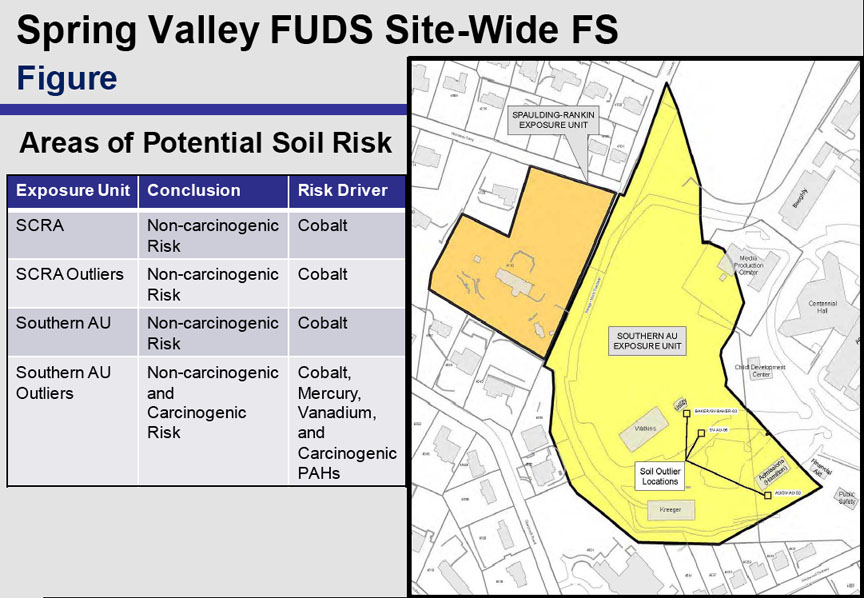
The draft-final Feasibility Study (FS) was sent to our regulatory partners (EPA and DDOE) and Dr. Peter deFur, our independent Technical Assistance for Public Participation Program (TAPP) consultant for review ... The purpose of the FS is to develop, screen, and evaluate alternatives to achieve possible remedial action objectives addressing any unacceptable human health risks in or potential unacceptable explosive hazards identified in the Final Remedial Investigation Report ... As a reminder, the locations, referred to as exposure units (EU), where unacceptable human health risks in soil were identified are the Spaulding Captain Rankin Area (SCRA), and Southern American University (AU). The areas associated with unacceptable explosive hazards include impact areas, static test fire areas and possible munition disposal pits. The areas cover about 100 properties in the neighborhood.

The below chart (Table 5.2 from the draft Site-Wide Feasibility Study) shows the remediation alternatives that were analyzed against the EPA’s nine screening criterion established to address CERCLA requirements and technical and policy considerations ... Alternative 6 was determined to be the most favorable alternative to achieve the Remedial Action Objectives (RAOs). It is protective of human health and the environment, is compliant with "applicable or relevant and appropriate requirements" and will meet the RAOs in the shortest amount of time. However, the formal selection of the preferred alternative will be proposed and documented in the Proposed Plan, and subject to acceptance from our regulatory partners and the community.
The Corps'pondent
January 2016 (pg. 3)
The U.S. Army Corps of Engineers plans to resume removing World War I-era debris from Spring Valley in February, upon moving a protective tent at 4825 Glenbrook Road NW to its third and final location. The tent will be moved at the Glenbrook site above the former basement of the home that once stood there. The Army previously demolished that home after the site was found to be contaminated by the munitions testing station formerly located on the land of present-day American University. The Army has suspended its “shelter in place” emergency response program until the tent is moved, but the program will be tested about 30 days before the work resumes.
Northwest Current
Efforts in early December focused on preparing the site and relocating support equipment, as we incrementally arrange the tent at its third and final location ... In mid-December, the crews leveled the driveway and placed the first section of the tent into its final position. Additionally, crews constructed a pad area where the medical monitoring tent, one of the site's multiple layers of safety protocols, was placed behind Tent 3. In January, the team will resume using the crane to move the final two sections of the tent into their final locations so the entire Engineering Control Structure (ECS) can be reassembled ... We will notify everyone prior to reinstating the Shelter-in-Place program, and will share further details when we have a firm date for the start of that next phase of high probability operations.
Brenda Barber, Spring Valley Project Manager: USACE is conducting an investigation regarding the post-AUES development of three properties within the Spring Valley FUDS, focusing on 4825 Glenbrook Road, 4835 Glenbrook Road, and the Public Safety Building at 4400 Massachusetts Avenue on AU’s campus. The purpose is to identify additional potentially responsible parties (PRP) for the presence and/or extent of contamination at these sites ... Anyone who has information about this matter is encouraged to contact USACE’s PRP investigation contractor: Watermark, Inc. Contact information and brief details can be left on the contractor’s toll free phone number (866-383-7327) and James Carney will return the call to conduct a comprehensive interview.
Linda Argo, AU Representative clarified that, to her knowledge, AU does not know which fraternity constructed the Public Safety Building ...
The ultimate purpose of the PRP search is to determine whether any of the property developers and/or their subcontractors possessed any knowledge of the contamination at the site, and whether they exacerbated the extent of contamination during their activities, thus requiring the USACE to conduct larger remedial efforts than would have been necessary had the contamination remained undisturbed ... If the developer is identified as a PRP, then USACE may be able to recoup some of the remediation costs from the developer ...
Dan Noble, Spring Valley Project Manager explained that the Spring Valley FUDS cleanup is governed by the Comprehensive Environmental Response, Compensation, and Liability Act (CERCLA), which includes a liability framework for determining a wide range of parties that are potentially liable for site contamination. The USACE is a PRP for the Spring Valley FUDS and has spent significant time and funding on site cleanup. D. Noble further explained that as soon as USACE has spent cleanup funding at the site, they are permitted to pursue other PRPs for the purpose of sharing cleanup costs.
Spring Valley FUDS
RAB Meeting Minutes
January 8, 2013 (pgs. 12 - 14)
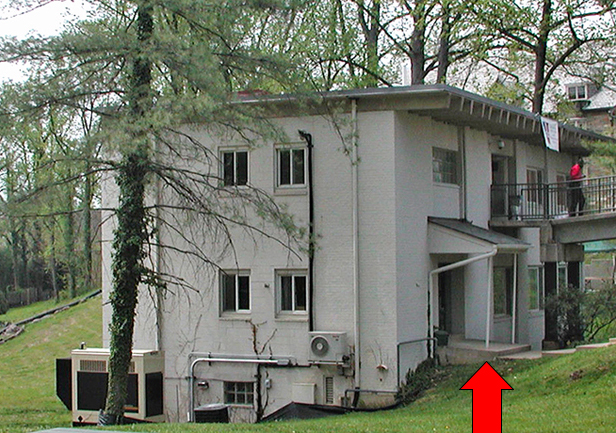
The Army Corps of Engineers unearthed more munitions debris next to the Public Safety building during this winter break. On Jan. 4, workers found a single 75mm round buried four feet underneath a concrete slab that they had removed in front of the building’s lower entrance ... Although heavily corroded and empty, the projectile was still largely intact ... Kent Slowinski, a community activist and former Restoration Advisory Board member, said recent work conducted by the Army Corps indicates a likelihood that the debris field around the Public Safety building extends underneath the building, because debris from the AU Experimental Station has been found behind and in front of it.
Christopher Cottrell
The Eagle
January 21, 2010
Karnack, TX — No end is in sight in a dispute between the U.S. Army and Environmental Protection Agency over cleanup at the former Longhorn Army Ammunition Plant at Caddo Lake. The Caddo Lake Clearinghouse — which consists of groups that advocate for the lake — heard during a meeting this week that the dispute over the former ammo plant site boils down to an argument about how well the groundwater must be cleaned up ... "We've been waiting for a couple of years at least (to get the groundwater cleaned). Neither the Army nor the EPA can tell us when it's going to end," [chair of the Restoration Advisory Board Paul] Fortune said ... Hydrologist George Rice, during his presentation at the Thursday meeting, said perchlorate has been identified as the groundwater contaminant ... Rice said: "Last year, the EPA said the perchlorate standard would be out this year … The Army agrees that whatever the drinking water standard is, that will become the cleanup standard."
Caleb Brabham
Longview News-Journal
October 16, 2015
Longhorn Army Ammunition Plant (LHAAP) is a former, government-owned, contractor-operated and maintained Department of Defense facility located in central-east Texas in the northeastern corner of Harrison County. The footprint of the former U.S. Army installation occupies 8,416 acres between State Highway 43 at Karnack, Texas, and the southwestern shore of Caddo Lake ... Studies conducted at LHAAP identified contaminants such as volatile organic compounds (VOCs), perchlorate, metals and explosives in on-site soil and groundwater. These areas of contamination are subject to investigation and cleanup under the Comprehensive Environmental Response, Compensation, and Liability Act (CERCLA).
[Public participant William] Echols asked again why EPA wants residential standards applied when the land will never be used as residential. [EPA Region 6 representative Steve] Tzhone answered that EPA has a policy to restore groundwater to its highest beneficial use ... Mr. Tzhone stated that this is a national policy and the intent is for the policy to be applied across the board to all states ... [Public participant Lee] Eisenberg said that, with water resources being scarce, it’s probably only a matter of time before there is a need to use this water ... [EPA Region 6 representative Steve] Mayer commented that EPA is working on development of a perchlorate standard, and has been working on it for many years. Although the first proposed perchlorate MCL of 15 μg/L was withdrawn due to lack of scientific basis, a new proposed perchlorate standard is anticipated next year.
LHAAP FUDS
RAB Minutes
November 20, 2014 (pgs. 8 - 10)
The Corps of Engineers is conducting an investigation to determine to what extent American University Experiment Station-related activities may have impacted the groundwater within the Formerly Used Defense Site. The investigation involves the installation of monitoring wells and the collection of samples from the wells and additional surface water locations. To date, the Corps of Engineers has installed 53 wells and collected a number of surface water samples. Perchlorate has been detected at levels above the EPA interim drinking water health advisory of 15 parts per billion (ppb) at two locations in the project area, with a highest detection level of 146 ppb identified on American University’s campus [and the other in front of 4820 Glenbrook Road]. Groundwater is not used as a drinking water source in Spring Valley.
 Free Hit Counter