Nov 5, 2015

Corps Pursues "PRP" Investigation to Recoup Added Cleanup Costs

Brenda Barber, Spring Valley Project Manager: USACE is conducting an investigation regarding the post-AUES development of three properties within the Spring Valley FUDS, focusing on 4825 Glenbrook Road, 4835 Glenbrook Road, and the Public Safety Building at 4400 Massachusetts Avenue on AU’s campus.  The purpose is to identify additional potentially responsible parties (PRP) for the presence and/or extent of contamination at these sites ... Anyone who has information about this matter is encouraged to contact USACE’s PRP investigation contractor: Watermark, IncContact information and brief details can be left on the contractor’s toll free phone number (866-383-7327) and James Carney will return the call to conduct a comprehensive interview.
 
Linda Argo, AU Representative clarified that, to her knowledge, AU does not know which fraternity constructed the Public Safety Building ...

The ultimate purpose of the PRP search is to determine whether any of the property developers and/or their subcontractors possessed any knowledge of the contamination at the site, and whether they exacerbated the extent of contamination during their activities, thus requiring the USACE to conduct larger remedial efforts than would have been necessary had the contamination remained undisturbed ... If the developer is identified as a PRP, then USACE may be able to recoup some of the remediation costs from the developer ...

Dan Noble, Spring Valley Project Manager explained that the Spring Valley FUDS cleanup is governed by the Comprehensive Environmental Response, Compensation, and Liability Act (CERCLA), which includes a liability framework for determining a wide range of parties that are potentially liable for site contamination.  The USACE is a PRP for the Spring Valley FUDS and has spent significant time and funding on site cleanup.  D. Noble further explained that as soon as USACE has spent cleanup funding at the site, they are permitted to pursue other PRPs for the purpose of sharing cleanup costs.

Spring Valley FUDS 
RAB Meeting Minutes
January 8, 2013 (pgs. 12 - 14)
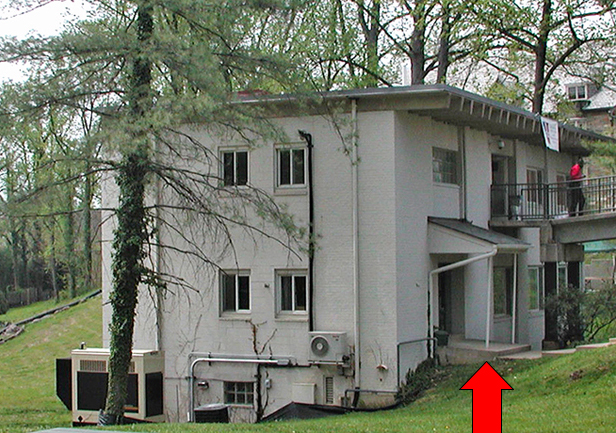
The Army Corps of Engineers unearthed more munitions debris next to the Public Safety building during this winter break.  On Jan. 4, workers found a single 75mm round buried four feet underneath a concrete slab that they had removed in front of the building’s lower entrance ... Although heavily corroded and empty, the projectile was still largely intact ... Kent Slowinski, a community activist and former Restoration Advisory Board member, said recent work conducted by the Army Corps indicates a likelihood that the debris field around the Public Safety building extends underneath the building, because debris from the AU Experimental Station has been found behind and in front of it.
Christopher Cottrell
The Eagle
January 21, 2010
Oct 16, 2015

Case Study: Army-EPA Standoff over FUDS Perchlorate Cleanup

Karnack, TX — No end is in sight in a dispute between the U.S. Army and Environmental Protection Agency over cleanup at the former Longhorn Army Ammunition Plant at Caddo Lake.  The Caddo Lake Clearinghouse — which consists of groups that advocate for the lake — heard during a meeting this week that the dispute over the former ammo plant site boils down to an argument about how well the groundwater must be cleaned up ... "We've been waiting for a couple of years at least (to get the groundwater cleaned).  Neither the Army nor the EPA can tell us when it's going to end," [chair of the Restoration Advisory Board Paul] Fortune said ... Hydrologist George Rice, during his presentation at the Thursday meeting, said perchlorate has been identified as the groundwater contaminant ... Rice said: "Last year, the EPA said the perchlorate standard would be out this year … The Army agrees that whatever the drinking water standard is, that will become the cleanup standard."
Caleb Brabham
Longview News-Journal
October 16, 2015
Longhorn Army Ammunition Plant (LHAAP) is a former, government-owned, contractor-operated and maintained Department of Defense facility located in central-east Texas in the northeastern corner of Harrison County.  The footprint of the former U.S. Army installation occupies 8,416 acres between State Highway 43 at Karnack, Texas, and the southwestern shore of Caddo Lake ... Studies conducted at LHAAP identified contaminants such as volatile organic compounds (VOCs), perchlorate, metals and explosives in on-site soil and groundwater.  These areas of contamination are subject to investigation and cleanup under the Comprehensive Environmental Response, Compensation, and Liability Act (CERCLA).
[Public participant William] Echols asked again why EPA wants residential standards applied when the land will never be used as residential.  [EPA Region 6 representative Steve] Tzhone answered that EPA has a policy to restore groundwater to its highest beneficial use ... Mr. Tzhone stated that this is a national policy and the intent is for the policy to be applied across the board to all states ... [Public participant Lee] Eisenberg said that, with water resources being scarce, it’s probably only a matter of time before there is a need to use this water ... [EPA Region 6 representative Steve] Mayer commented that EPA is working on development of a perchlorate standard, and has been working on it for many years.  Although the first proposed perchlorate MCL of 15 μg/L was withdrawn due to lack of scientific basis, a new proposed perchlorate standard is anticipated next year
LHAAP FUDS
RAB Minutes
November 20, 2014 (pgs. 8 - 10)
The Corps of Engineers is conducting an investigation to determine to what extent American University Experiment Station-related activities may have impacted the groundwater within the Formerly Used Defense Site.  The investigation involves the installation of monitoring wells and the collection of samples from the wells and additional surface water locations.  To date, the Corps of Engineers has installed 53 wells and collected a number of surface water samples.  Perchlorate has been detected at levels above the EPA interim drinking water health advisory of 15 parts per billion (ppb) at two locations in the project area, with a highest detection level of 146 ppb identified on American University’s campus [and the other in front of 4820 Glenbrook Road].  Groundwater is not used as a drinking water source in Spring Valley.

Sep 11, 2015

Who Could Forget When Chemical Weapons Were Tested in D.C.?

Col. Smith S. Leach was a West Point grad (class of 1875) who worked on river and harbor improvements around the country, prepared “The Engineer’s Field Manual” for the Army and was in charge of the District’s water supply.  He died in 1909 and was buried at Arlington National Cemetery.  Nine years later, the Army decided to rename one of Washington’s newest military installations in his honor.  Camp Leach had formerly — and briefly — been known as American University Camp, for that was where it was located: on 650 acres of land donated by the college in Spring Valley in Northwest Washington ... During World War I, the Army created and tested chemical weapons at Camp Leach and at a contiguous facility called the American University Experiment Station ... Eventually, the Army’s Chemical Warfare Service took over.  Engineers performed gas-mask research, investigated offensive and defensive chemicals, and developed smoke mixtures for Navy smoke screens and Army battlefield signaling.  
Hundreds of different gases were tested in Spring Valley, including mustard gas, phosgene and ammonium cyanide ... The war ended on Nov. 11, 1918.  The Army moved out of Spring Valley in 1921.  Somehow, people forgot what had gone on there.  They were reminded on Jan. 6, 1993, when a contractor digging a utility trench on 52nd Court NW noticed something odd in the bucketful of dirt his backhoe had just unearthed: a canister that made “a sloshing sound.”  Ruh-roh.  Ever since then, the U.S. Army Corps of Engineers has overseen a cleanup in what is now one of Washington’s toniest neighborhoods.  About $260 million has been spent so far, said Dan Noble, project manager for the U.S. Army Corps of Engineers’ Baltimore District. Work is expected to be finished around 2020.  It doesn’t sound as if the War to End All Wars is quite over.
John Kelly
Washington Post
September 5, 2015

Sep 4, 2015

Spring Valley Environmental Writer Janet Bohlen Dies at Home at 86

Janet T. Bohlen, 86, an environmental writer, conservationist and former communications director for the World Wildlife Fund, died Aug. 3 at her home in Lexington, Mass.  The cause was complications from lymphoma, said her husband, Curtis Bohlen.  The Bohlens moved to Lexington from the District in 2013.  Mrs. Bohlen was born Janet Trowbridge in New York and grew up in Washington.  In the late 1980s, she was communications director for the World Wildlife Fund.  She also worked for the National Trust for Historic Preservation.  Among her books was For the Wild Places: Profiles in Conservation (1993), about five leaders in conservation biology.  As a young woman, she worked for the CIA in Norway and later accompanied her husband on Foreign Service assignments in Afghanistan and Egypt.
Washington Post 
September 4, 2015
 

Janet Bohlen inspects a faded 1918 photo of a dozen Army soldiers standing shoulder-deep in rugged trenches.  The uniformed men aim their rifles at an unseen target behind American University.  “It looks like they’re right on the playing field, doesn’t it?” she says, sitting in her living room.  “Wouldn’t you love to be able to identify exactly where that is now?”  From the other side of her coffee table, her husband, Buff, quips, “Don’t you recognize your own back yard?”  The Bohlens have lived in the Spring Valley section of Northwest Washington for 52 years, raising three children and now settling into retirement ... 
In the early 2000s, the Army Corps found the vestiges of a shed once filled with detonators under a 70-year-old tree in the Bohlens’ back yard, where Janet Bohlen said her daughter and neighborhood children would often play.  Her daughter had severe mercury poisoning years before the discoveries, but Janet said there is no way for her family to know whether the Army artifacts and that condition were related.  Janet has been treated for non-Hodgkin’s lymphoma, a condition the 2007 study recognized as potentially arsenic-related.
Sylvia Carignan
Washington Post
December 11, 2011

Aug 6, 2015

DC Attorney General May Sue Fordham Road Property Owner

Ten Spring Valley homeowners — along with Pepco and the National Park Service — have not allowed the U.S. Army Corps of Engineers to inspect their properties for hazards left over from the World War I-era munitions testing station at American University ...  Another property owner, in the 3700 block of Fordham Road, allowed a surface inspection of his property but did not let the Army “intrusively investigate it.”  The property has a potential burial pit of leftovers from the experimental station’s activities.  The surface inspection found 27 “anomalies” or unknown metallic items underneath the ground surface, as well as arsenic contamination, according to the Remedial Investigation Report.  The report’s maps show that the potential burial pit is located at 3720 Fordham Road ...  
When asked why there have not been any lawsuits to force owners to grant the Army access, Steve Hirsh of the U.S. Environmental Protection Agency said the agency would take legal action only if the Army were confident that a particular property held dangerous contamination.  In a later interview, D.C. Attorney General Karl Racine said he would assess whether it would be appropriate for his office to initiate a lawsuit.  The Army is continuing to actively look for dangerous chemicals and military hardware on 96 properties west of American University and in an area between Dalecarlia Parkway and Fordham Road.
Northwest Current
July 22, 2015

The community deserves to know why the Army believes there is a burial pit at 3720 Fordham Road and precisely what that pit might contain.  Long-timers will recall that the surprise discovery of a munitions burial pit at 52nd Court in 1993 was the beginning of the Army’s enduring 23-year, $250 million cleanup of the 661-acre Spring Valley Formerly Used Defense Site.  During World War I, that pit — located southeast of circular test trenches where chemical weapons were statically fired (meaning they were detonated in a fixed position) — was used to dispose of dud shells that were too dangerous to haul back to the Experiment Station at American University nearly a mile away.  Back then, the chemical corps’ standard operating procedures specified having 4-foot-deep holes near any chemical weapons bunker so that, if leaky shells were discovered, they could immediately be put aside.
 
Another set of circular test trenches was identified as the Sedgwick Trench (POI 1), where “extensive field testing of Chemical Warfare Agents such as mustard, phosgene, chloropicrin and cyanogen chloride” was performed [Site-Wide Remedial Investigation Report, Section 1.5.3, page 11] ...  The D.C. environmental agency noticed another anomaly adjacent to and southeast of the Sedgwick Trench in the backyard of 3720 Fordham Road.  It was tagged as POI 2 and described as a possible pit used for the disposal of duds and “other material.”   The homeowner cooperated with the search at first and allowed Army access for a geophysical survey that was eventually conducted in 2004.  Although survey maps subsequently documented a large “anomalous area,” deeper than 4 feet below ground surface in the north half of the backyard, the Army Corps has futilely sought the property owner’s permission to intrusively investigate the POI 2 burial pit ever since. 
Allen Hengst

Jun 25, 2015

Top Secret WW II Chemical Experiments Segregated By Race

When officers led [Rollins Edwards] and a dozen others into a wooden gas chamber and locked the door, he didn't complain.  None of them did.  Then, a mixture of mustard gas and a similar agent called lewisite was piped inside.  "It felt like you were on fire," recalls Edwards, now 93 years old.  "Guys started screaming and hollering and trying to break out.  And then some of the guys fainted.  And finally they opened the door and let us out, and the guys were just, they were in bad shape." 
Edwards was one of 60,000 enlisted men enrolled in a once-secret government program — formally declassified in 1993 — to test mustard gas and other chemical agents on American troops.  But there was a specific reason he was chosen: Edwards is African-American ... While the Pentagon admitted decades ago that it used American troops as test subjects in experiments with mustard gas, until now, officials have never spoken about the tests that grouped subjects by race ... All of the World War II experiments with mustard gas were done in secret and weren't recorded on the subjects' official military records.  Most do not have proof of what they went through.  They received no follow-up health care or monitoring of any kind. 
And they were sworn to secrecy about the tests under threat of dishonorable discharge and military prison time, leaving some unable to receive adequate medical treatment for their injuries, because they couldn't tell doctors what happened to them ... Mustard gas damages DNA within seconds of making contact.  It causes painful skin blisters and burns, and it can lead to serious, and sometimes life-threatening illnesses including leukemia, skin cancer, emphysema and asthma ... Defiance was unthinkable, [Edwards] says, especially for black soldiers.  "You do what they tell you to do and you ask no questions," he says.
Caitlin Dickerson
National Public Radio
June 22, 2015

May 20, 2015

Army Briefs Residents on Draft 5-Year Site-Wide Cleanup Plan

Spring Valley residents expressed concerns about the proposed five-year timeline for removing any remaining hazardous remains left from World War I-era chemical weapons testing in the area at a community meeting last week ... The U.S. Army has been working to clean up Spring Valley for more than two decades, addressing materials that its former munitions testing facility on the American University campus left behind nearly a century ago.
   
Dan Noble, the Spring Valley cleanup project manager from the Army Corps, said a comment period on a recently released Remedial Investigation Report will end on May 26 ...  The risk factors in Spring Valley fall into two categories: chemical concerns in the soil and risks associated with munitions and explosives.   The areas affected include the southern portion of American University’s campus and the surrounding residential neighborhood ...  
Dan Noble
One resident, Mara Miller, urged the Army to take more decisive action to clean up the neighborhood.  Through occasional tears, Miller said she suffers from a rare immunodeficiency disease that she believes she contracted as a result of her family living in Spring Valley for more than 50 years. “I think the most important part is we find the chemicals and get rid of them,” Miller said ...  Noble asked Miller to submit a written comment in the interest of time.  After the comment period ends, the Army Corps staff will read and respond to each comment individually, he said.  
Mark Lieberman
Northwest Current
May 20, 2015

  
Lauren Mara Miller 
Mara Miller: [pg. 9]  Some of my neighbors got together over a period of years and reported health problems — there's 26 pages worth of people — house after house after house — but no one [here] wants to talk about it.  It's like a big elephant in the room that no one wants to mention ... I'm here because I was once a kid who got poisoned by that and a grown-up who got poisoned.  And I don't want it to happen to anybody else ... [pg. 14] It's horrible to have your property locked up, but it worse when you whole life is ruined and shortened.
Mara Miller
Remedial Investigation Report
Community Meeting
May 12, 2015
 
Hit CountersFree Hit Counter