Aug 6, 2015

DC Attorney General May Sue Fordham Road Property Owner

Ten Spring Valley homeowners — along with Pepco and the National Park Service — have not allowed the U.S. Army Corps of Engineers to inspect their properties for hazards left over from the World War I-era munitions testing station at American University ...  Another property owner, in the 3700 block of Fordham Road, allowed a surface inspection of his property but did not let the Army “intrusively investigate it.”  The property has a potential burial pit of leftovers from the experimental station’s activities.  The surface inspection found 27 “anomalies” or unknown metallic items underneath the ground surface, as well as arsenic contamination, according to the Remedial Investigation Report.  The report’s maps show that the potential burial pit is located at 3720 Fordham Road ...  
When asked why there have not been any lawsuits to force owners to grant the Army access, Steve Hirsh of the U.S. Environmental Protection Agency said the agency would take legal action only if the Army were confident that a particular property held dangerous contamination.  In a later interview, D.C. Attorney General Karl Racine said he would assess whether it would be appropriate for his office to initiate a lawsuit.  The Army is continuing to actively look for dangerous chemicals and military hardware on 96 properties west of American University and in an area between Dalecarlia Parkway and Fordham Road.
Northwest Current
July 22, 2015

The community deserves to know why the Army believes there is a burial pit at 3720 Fordham Road and precisely what that pit might contain.  Long-timers will recall that the surprise discovery of a munitions burial pit at 52nd Court in 1993 was the beginning of the Army’s enduring 23-year, $250 million cleanup of the 661-acre Spring Valley Formerly Used Defense Site.  During World War I, that pit — located southeast of circular test trenches where chemical weapons were statically fired (meaning they were detonated in a fixed position) — was used to dispose of dud shells that were too dangerous to haul back to the Experiment Station at American University nearly a mile away.  Back then, the chemical corps’ standard operating procedures specified having 4-foot-deep holes near any chemical weapons bunker so that, if leaky shells were discovered, they could immediately be put aside.
 
Another set of circular test trenches was identified as the Sedgwick Trench (POI 1), where “extensive field testing of Chemical Warfare Agents such as mustard, phosgene, chloropicrin and cyanogen chloride” was performed [Site-Wide Remedial Investigation Report, Section 1.5.3, page 11] ...  The D.C. environmental agency noticed another anomaly adjacent to and southeast of the Sedgwick Trench in the backyard of 3720 Fordham Road.  It was tagged as POI 2 and described as a possible pit used for the disposal of duds and “other material.”   The homeowner cooperated with the search at first and allowed Army access for a geophysical survey that was eventually conducted in 2004.  Although survey maps subsequently documented a large “anomalous area,” deeper than 4 feet below ground surface in the north half of the backyard, the Army Corps has futilely sought the property owner’s permission to intrusively investigate the POI 2 burial pit ever since. 
Allen Hengst

Jun 25, 2015

Top Secret WW II Chemical Experiments Segregated By Race

When officers led [Rollins Edwards] and a dozen others into a wooden gas chamber and locked the door, he didn't complain.  None of them did.  Then, a mixture of mustard gas and a similar agent called lewisite was piped inside.  "It felt like you were on fire," recalls Edwards, now 93 years old.  "Guys started screaming and hollering and trying to break out.  And then some of the guys fainted.  And finally they opened the door and let us out, and the guys were just, they were in bad shape." 
Edwards was one of 60,000 enlisted men enrolled in a once-secret government program — formally declassified in 1993 — to test mustard gas and other chemical agents on American troops.  But there was a specific reason he was chosen: Edwards is African-American ... While the Pentagon admitted decades ago that it used American troops as test subjects in experiments with mustard gas, until now, officials have never spoken about the tests that grouped subjects by race ... All of the World War II experiments with mustard gas were done in secret and weren't recorded on the subjects' official military records.  Most do not have proof of what they went through.  They received no follow-up health care or monitoring of any kind. 
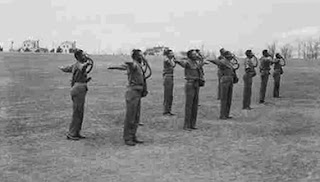
And they were sworn to secrecy about the tests under threat of dishonorable discharge and military prison time, leaving some unable to receive adequate medical treatment for their injuries, because they couldn't tell doctors what happened to them ... Mustard gas damages DNA within seconds of making contact.  It causes painful skin blisters and burns, and it can lead to serious, and sometimes life-threatening illnesses including leukemia, skin cancer, emphysema and asthma ... Defiance was unthinkable, [Edwards] says, especially for black soldiers.  "You do what they tell you to do and you ask no questions," he says.
Caitlin Dickerson
National Public Radio
June 22, 2015

May 20, 2015

Army Briefs Residents on Draft 5-Year Site-Wide Cleanup Plan

Spring Valley residents expressed concerns about the proposed five-year timeline for removing any remaining hazardous remains left from World War I-era chemical weapons testing in the area at a community meeting last week ... The U.S. Army has been working to clean up Spring Valley for more than two decades, addressing materials that its former munitions testing facility on the American University campus left behind nearly a century ago.
   
Dan Noble, the Spring Valley cleanup project manager from the Army Corps, said a comment period on a recently released Remedial Investigation Report will end on May 26 ...  The risk factors in Spring Valley fall into two categories: chemical concerns in the soil and risks associated with munitions and explosives.   The areas affected include the southern portion of American University’s campus and the surrounding residential neighborhood ...  
Dan Noble
One resident, Mara Miller, urged the Army to take more decisive action to clean up the neighborhood.  Through occasional tears, Miller said she suffers from a rare immunodeficiency disease that she believes she contracted as a result of her family living in Spring Valley for more than 50 years. “I think the most important part is we find the chemicals and get rid of them,” Miller said ...  Noble asked Miller to submit a written comment in the interest of time.  After the comment period ends, the Army Corps staff will read and respond to each comment individually, he said.  
Mark Lieberman
Northwest Current
May 20, 2015

  
Lauren Mara Miller 
Mara Miller: [pg. 9]  Some of my neighbors got together over a period of years and reported health problems — there's 26 pages worth of people — house after house after house — but no one [here] wants to talk about it.  It's like a big elephant in the room that no one wants to mention ... I'm here because I was once a kid who got poisoned by that and a grown-up who got poisoned.  And I don't want it to happen to anybody else ... [pg. 14] It's horrible to have your property locked up, but it worse when you whole life is ruined and shortened.
Mara Miller
Remedial Investigation Report
Community Meeting
May 12, 2015

May 7, 2015

Army Corps Comes Clean, Releases Suppressed 1986 Photo Analysis

This report utilizes historical aerial photography to identify potential problem areas at American University, Washington, D.C., originating from past activities at a World War I Chemical Warfare Experimental Station.  During World War I the Bureau of Mines was allowed to use American University and surrounding property to conduct research and small-scale testing of chemical warfare items.  In 1986 American University requested assistance from the Department of the Army in obtaining information relating to these activities.  

Three years of historical aerial photography (1918, 1927, and 1937) were obtained and analyzed by the U.S. EPA's Environmental Photographic Interpretation Center (EPIC) ... Significant features identified include shell pits, trenches, possible test areas, and possible burial sites ... The location of those features identified in the analysis that are related to possible disposal (burial) of munitions and chemical agents have been transferred to a 1982 aerial photograph. 
EPIC
Historical Photographic Analysis
July 1986, Vol. I (pgs. 24, 28)
1986 EPIC Photo Analysis, Vol. II (fig. 2)
Allen Hengst: [47:05]  Did the report identify areas other than Bender Arena where there might be buried munitions in Spring Valley?
   
Dan Noble: I don't believe so.  I mean, we'd have to get the report and see the conclusions ... 

 
Hengst:  Well, I've read about it and I think they did identify areas outside Bender Arena.  So that becomes a crucial event.  In 1986, which was seven years before the discoveries on 52nd Court — before the beginning of Operation Safe Removal — AU knew, the Army knew and EPA knew but they kept quiet about it ... 

  
Noble:  I mean, let's think about this.  In 1920 the Army completed its activities at American University Experiment Station and left.  Since then, the Army knew what it did ... Institutionally, the Army knew what it did since 1917 ... 

  
Ginny Durrin I think, to be historically accurate, you should include all of the documentation that was produced by this 1986 effort ... There are aerial maps of Spring Valley showing the ground scars, showing the points of interest (or things that were going to become "Points of Interest") ... Those documents should be in the Tenley Public Library.

     
Noble
:
  [50:31] I think they are.  If they're not, I'll get a copy of the report and put it in there.

Spring Valley RAB Meeting
May 5, 2015 (audio recording)

Apr 22, 2015

Norton Presses USACE Chief to Expedite Spring Valley Cleanup

Congresswoman Eleanor Holmes Norton (D-DC) is trying to expedite federal efforts to excavate and restore the Spring Valley FUDS, located in Spring Valley, the residential neighborhood near American University.  At a Water Resources & Environment Subcommittee hearing, Norton, a senior member of the subcommittee, asked Lieutenant General Thomas Bostick, Chief of Engineers, United States Army Corps of Engineers,  if there was any way to speed the project’s timeline.  Norton requested a response from the Corps within 30 days ... 
Norton said: “If there are dangerous chemicals that still hide in this highly residential neighborhood, the sooner we know it the better"... Norton has been working with the Army Corps since 1993 to clean up the site, where numerous toxins, including arsenic, lewisite and mustard gas, have been found.  Unlike most FUDS, Spring Valley is the home of a major university, American University, which has more than 12,000 students, and is located in a sought after, densely populated residential area.
Congresswoman Eleanor Holmes Norton
Press Release
April 22, 2015

Del. Norton: [1:32]  During WW I there were chemical weapons manufactured in one of our neighborhoods ... Because all the information wasn't known, one of our most illustrious communities was built over that.  The Corps has pledged to make sure that community is cleaned up ... I don't know if you've ever had an older project than this, but we're talking about 25 years if we keep this up ... I have to ask you, General Bostick, is there any way to speed up this timeline, considering we're talking about a neighborhood where real people live and go to work every day and have had to abide this work for almost 25 years? ...

Gen. Bostick: [1:34] I know that they're working as hard and as diligently and as safely as they can ... Honestly, I suspect that they're going as quickly as they can.

Del. Norton: [1:35] I was sure that you would say that and I'm sure that they are, but I wish that you would get back to me — perhaps within a month's time — and see whether there's any way to speed up that timeline.   


Apr 8, 2015

45-Day Public Comment Period Begins for Draft RI Report

The U.S. Army Corps of Engineers, Baltimore District is releasing the draft Remedial Investigation report for the Spring Valley Formerly Used Defense Site (FUDS) in accordance with the Comprehensive Environmental Response, Compensation, and Liability Act, or CERLCA.  The Remedial Investigation report details 22 years worth of investigations and work, such as removals of arsenic contaminated soil and munitions related items that have taken place at the Spring Valley FUDS.  The report also outlines the potential unacceptable risks and hazards thought to remain within the Spring Valley FUDS ... The Feasibility Study will outline how the Corps of Engineers plans to address any potential unacceptable risks and hazards.  
After the Feasibility Study we will prepare a Proposed Plan, which will identify a preferred clean-up action to address remaining risks and hazards.  You are encouraged to review the Remedial Investigation report in the public record and submit comments on the report ... A 45-day public comment period will run from April 8 - May 26, 2015.  Written comments can be sent to the following mailing address: U.S. Army Corps of Engineers, ATTN: Brittany Bangert, Rm. 11400, 10 South Howard St., Baltimore, Md. 21201; or by e-mail to: Brittany Bangert no later than May 26, 2015.  Mailed letters must be postmarked by May 23, 2015.
Legal Notice
Washington Post
April 8, 2015

Mar 25, 2015

Corps Hopes to Complete Spring Valley Site-Wide Cleanup by 2020

The U.S. Army Corps of Engineers says it will return to Spring Valley every five years after completing its cleanup in 2020, to check that the area is verifiably free of contamination.  The Army has been working for over two decades — and has spent over $200 million — to rid the neighborhood of munitions and chemical contamination left there during World War I, when American University hosted a munitions testing site.  While the plan is to finish remediating the site within the next five years, the Army Corps will “check in perpetuity,” Dan Noble, who  manages the cleanup effort, told the community at a recent meeting of the Restoration Advisory Board ...  
This new pledge to stay involved is a significant and welcome shift from the past: About a decade and a half ago, the Army declared the neighborhood clean.  Luckily, the D.C. Health Department raised doubts.  When the cleanup resumed, workers soon found elevated arsenic levels in the soil near American University’s child development center and intramural fields, as well as buried munitions on Glenbrook Road.  This time, we look forward to both an accurate bill of health and continuing checkups to ensure that status is maintained.
Editorial
Northwest Current
March 25, 2015

Dan NobleCERCLA is the environmental regulation that guides our efforts here at the site ... The remedial investigation phase that we are reporting on in tonight's presentation, is right here at the yellow star ... The report looks at all the effort that we've done and all the data that we've gathered and is basically intended to boil it down to what really matters ... We've thought about the tentative schedule to get through the process and to get to the point where we're actually taking action to address these cleanups.  We want to finalize the RI Report by early summer, complete the Feasibility Study by the end of the year, by next spring we want to bring you a Proposed Plan and by the end of summer [2016] have the Decision Document signed.  So we hope by the start of calendar year 2017 that we can start undertaking some of these actions.
Dan Noble, Project Manager
Spring Valley RAB Meeting
March 10, 2015
 
Hit CountersFree Hit Counter