skip to main |
skip to sidebar
 Detailed Analysis of Remaining Alternatives
Brenda Barber, Project Manager
RAB Meeting
September 13, 2011  Remedial Actions Under Alternative 5
In response to a question from commissioner Kent Slowinski following her presentation at the September 9th Advisory Neighborhood Commission 3-D meeting, U.S. Army Corps of Engineers project manager Brenda Barber acknowledged that a ten-year-old videotape transcript, of an interview with construction workers who helped build the house at 4825 Glenbrook Road in 1992, is in the Army's possession.
SLOWINSKI (33:12): Have you talked to the construction workers who built the house, many of whom suffered exposure to chemical warfare agent? ... There's a videotaped interview where the construction workers were sitting around a site plan of the property and they pointed to areas on the property where they said they found munitions or bottles filled with chemicals. They even went on to say, "You can find more munitions behind this wall."
 4825 Glenbrook Road Project Mgr. Brenda Barber
[DC Department of Health environmental scientist] Richard Albright investigated further and found that five workers building 4825 Glenbrook Road had fled the site in May 1992 when fumes from broken lab glassware and contaminated soil caused pain in their eyes and lungs. Suffering from eye pain and burning skin, some of the workers went to a hospital emergency room. It was beginning to look as if both [AU President Benjamin] Ladner's house [at 4835] and 4825 Glenbrook had been built on top of a laboratory-waste dump.
Harry Jaffe
The Washingtonian
December 1, 2000
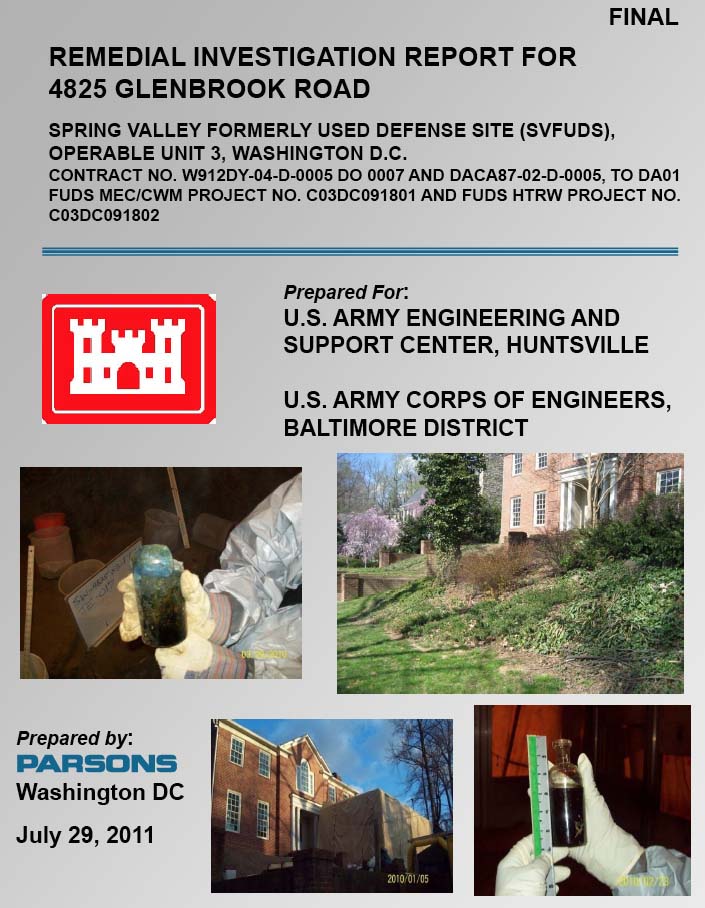
 The U.S. Army Corps of Engineers is recommending tearing down a Spring Valley home to identify and remove World War I-era munitions and chemicals feared to be buried beneath it. Since 2000, the Army Corps has removed more than 500 munitions items, 400 pounds of laboratory glassware and more than 100 tons of soil contaminated with arsenic and other hazardous substances from 4825 Glenbrook Road, officials said.
... In 1918, 4825 Glenbrook Road was a dumpsite for chemical and explosive munitions and related debris; officials believe a pit was disturbed when the home was built, scattering that material throughout the property. The Army is now proposing to clean up whatever it finds beneath the home to a depth of 12 feet, spending an estimated $12.5 million to restore the site to residential standards.Brady Holt Northwest Current August 10, 2011 (pg. 1)
 No Entry: Source Area Investigation
The installation of sixteen temporary wells at American University in the vicinity of Kreeger Hall was completed in an effort to identify the source of elevated perchlorate levels in the groundwater in this area. The wells were installed, sampled and closed during a three-week period in July ... Also this month, data generated from the first quarterly sampling effort in May at existing groundwater monitoring wells and surface water locations, such as creeks and streams, was reviewed.

Drilling for Groundwater at Source Area #2
The field team plans to conduct the second quarterly sampling effort the first week of August to assess whether seasonal fluctuations affect contaminant levels in groundwater within the Spring Valley project area. Three new deep groundwater monitoring wells are expected to be installed later this year to determine if perchlorate has migrated into the deeper groundwater flow areas.
 Congresswoman Eleanor Holmes Norton [D-DC] today will offer an amendment on the House floor to the Defense Appropriations bill to provide the U.S. Army Corps of Engineers with $1 million to study the health effects of the Spring Valley Formerly Used Defense Site (FUDS) located in upper Northwest Washington, DC ... Under House Rules, Members may no longer earmark funds to a specific jurisdiction or project. However, Norton's amendment would require the study or studies to be done of FUDSs in cities with more than 500,000 residents where chemical agents were tested. Spring Valley appears to be the only FUDS that meets that definition.
Congresswoman Eleanor Holmes Norton
Press Release (July 6, 2011)
 On Thursday Norton took to the House floor and offered her amendment. For the Army, $1 million represents a comma in its budget, but no one's adding funds to anything; her amendment got voted down. But after the vote, Washington's Norm Dicks, top Democrat on the Appropriations Committee, said he could help direct funds for the health study. "I lost the amendment," Norton says, "but I might have won the issue."
Harry Jaffe
 To provide a follow-up analysis of the initial health study completed by Johns Hopkins Bloomberg School of Public Health approximately four years ago, the study will consist of: documenting community concerns about health impacts possibly related to the Spring Valley FUDS, conducting open communication on project methods and findings in conjunction with the previous work completed, following-up on issues raised in the initial 2007 Scoping Study, and providing specific resources and education as needed to community members, groups and other interested parties.
Solicitation for Follow-up on Spring Valley Health Study
To provide a follow-up analysis of the initial health study completed by Johns Hopkins Bloomberg School of Public Health approximately four years ago, the study will consist of: documenting community concerns about health impacts possibly related to the Spring Valley FUDS, conducting open communication on project methods and findings in conjunction with the previous work completed, following-up on issues raised in the initial 2007 Scoping Study, and providing specific resources and education as needed to community members, groups and other interested parties.
Solicitation for Follow-up on Spring Valley Health Study
DC Office of Contracting & Procurement
June 21, 2011
Amendment No. 1
June 27, 2011
 Spring Valley residents are hoping a proposed health study will be able to offer more information about the health effects of World War I-era contamination in their community. If the District and the Johns Hopkins School of Public Health successfully hammer out a contract, the school’s researchers will immediately begin an update on a 2007 study that found an elevated incidence of arsenic-related cancers and other illnesses in Spring Valley, according to Mary Fox, a lead researcher in the study ... The contamination occurred during World War I, when the U.S. Army used the American University campus to test chemical weapons, which it fired into the then-undeveloped woods that later became the Spring Valley community.
Brady Holt
Spring Valley residents are hoping a proposed health study will be able to offer more information about the health effects of World War I-era contamination in their community. If the District and the Johns Hopkins School of Public Health successfully hammer out a contract, the school’s researchers will immediately begin an update on a 2007 study that found an elevated incidence of arsenic-related cancers and other illnesses in Spring Valley, according to Mary Fox, a lead researcher in the study ... The contamination occurred during World War I, when the U.S. Army used the American University campus to test chemical weapons, which it fired into the then-undeveloped woods that later became the Spring Valley community.
Brady Holt
Northwest Current
July 13, 2011 (pg. 1)
 Perchlorate source area characterization and deep well installation will tentatively begin in June 2011. The 15 new temporary wells on AU‟s campus will be installed between the location where the highest perchlorate levels in Spring Valley were detected, and an existing up gradient well with low perchlorate levels ... The groundwater sampling results taken from the new temporary wells and the geophysical survey results from the area around Kreeger Hall will be evaluated to identify potential perchlorate source areas.
 Well #5 will be 15 feet north of highest perchlorate detections
 Well #9 will be 30 feet east of highest perchlorate detections
Restoration Advisory Board Meeting
May 10, 2011
 Free Hit Counter
 Detailed Analysis of Remaining Alternatives
 Remedial Actions Under Alternative 5
 4825 Glenbrook Road Project Mgr. Brenda Barber
 The U.S. Army Corps of Engineers is recommending tearing down a Spring Valley home to identify and remove World War I-era munitions and chemicals feared to be buried beneath it. Since 2000, the Army Corps has removed more than 500 munitions items, 400 pounds of laboratory glassware and more than 100 tons of soil contaminated with arsenic and other hazardous substances from 4825 Glenbrook Road, officials said.
 No Entry: Source Area Investigation
 Congresswoman Eleanor Holmes Norton [D-DC] today will offer an amendment on the House floor to the Defense Appropriations bill to provide the U.S. Army Corps of Engineers with $1 million to study the health effects of the Spring Valley Formerly Used Defense Site (FUDS) located in upper Northwest Washington, DC ... Under House Rules, Members may no longer earmark funds to a specific jurisdiction or project. However, Norton's amendment would require the study or studies to be done of FUDSs in cities with more than 500,000 residents where chemical agents were tested. Spring Valley appears to be the only FUDS that meets that definition.
 On Thursday Norton took to the House floor and offered her amendment. For the Army, $1 million represents a comma in its budget, but no one's adding funds to anything; her amendment got voted down. But after the vote, Washington's Norm Dicks, top Democrat on the Appropriations Committee, said he could help direct funds for the health study. "I lost the amendment," Norton says, "but I might have won the issue."
 Kent Slowinski & Ginny Durrin after the Palisades July 4th parade
 To provide a follow-up analysis of the initial health study completed by Johns Hopkins Bloomberg School of Public Health approximately four years ago, the study will consist of: documenting community concerns about health impacts possibly related to the Spring Valley FUDS, conducting open communication on project methods and findings in conjunction with the previous work completed, following-up on issues raised in the initial 2007 Scoping Study, and providing specific resources and education as needed to community members, groups and other interested parties.
 Spring Valley residents are hoping a proposed health study will be able to offer more information about the health effects of World War I-era contamination in their community. If the District and the Johns Hopkins School of Public Health successfully hammer out a contract, the school’s researchers will immediately begin an update on a 2007 study that found an elevated incidence of arsenic-related cancers and other illnesses in Spring Valley, according to Mary Fox, a lead researcher in the study ... The contamination occurred during World War I, when the U.S. Army used the American University campus to test chemical weapons, which it fired into the then-undeveloped woods that later became the Spring Valley community.
 Perchlorate source area characterization and deep well installation will tentatively begin in June 2011. The 15 new temporary wells on AU‟s campus will be installed between the location where the highest perchlorate levels in Spring Valley were detected, and an existing up gradient well with low perchlorate levels ... The groundwater sampling results taken from the new temporary wells and the geophysical survey results from the area around Kreeger Hall will be evaluated to identify potential perchlorate source areas.
  Well #5 will be 15 feet north of highest perchlorate detections
 Well #9 will be 30 feet east of highest perchlorate detections