Aug 9, 2012

New Approach Needed to Destroy Buried CWM at 250 Military Sites

WASHINGTON — The current approach for identifying and destroying buried chemical munitions and related chemical warfare materials uncovered during environmental remediation projects is neither reliable enough nor has the capability to efficiently tackle large-scale projects, says a new report from the National Research Council ...
Remediation of Buried Chemical Warfare Materiel
Following a 1985 directive from Congress, the Army has undertaken the monumental task of destroying the existing U.S. stockpile of chemical weapons. To date, 90 percent of the stockpile has been destroyed, and the remaining 10 percent is expected to be destroyed by 2022. However, during the early- to mid-20th century, chemical weapons and chemical warfare materiel were often disposed of by open pit burning and burial at approximately 250 sites in 40 states, the District of Columbia and three territories.
Remediation of this buried materiel, in addition to environmental cleanup of the burial sites, therefore poses significant challenges to the nation and DOD. The report examines important regulatory issues that ultimately affect the need, timing, and costs of remediating these sites. Federal and state environmental remediation policies address whether buried CWM must be excavated and destroyed or contained in place ...

FUDS with buried chemical WMD
The report recommends as a "matter of urgency" that the secretary of defense increase funding for the remediation of chemical warfare materiel to enable the Army to complete the inventories of known and suspected buried chemical munitions no later than 2013.
Remediation of Buried Chemical Warfare Materiel
National Academy of Sciences
August 6 2012

Aug 6, 2012

Family Asks to be Relocated During Demolition of Glenbrook House

A family on Glenbrook Road has asked the U.S. Army Corps of Engineers to pay for them to rent a home while the house across from theirs -- at 4825 Glenbrook -- is demolished ... The resident, who asked that her name not be published, has a 1-year-old and a 5-year-old and is worried that a problem could occur during the demolition. She said in an interview that her request was rejected by the Corps and has since gone to the appeal level. Dan Noble, co-chair of the Spring Valley Restoration Advisory Board and project manager of the area's cleanup, said he could not comment, as the matter is in the midst of "a formal legal process."

USACE Poster Session (7/17/12)
The Corps had hoped to knock down 4825 Glenbrook during the university's summer vacation, but because of delays in getting approval, work will probably take place this fall. "We can accommodate demolition during the school year," said [project manager Brenda] Barber, adding that the work should take between two and three weeks and be completed by the end of fall. Barber said additional engineering work must be done to protect adjacent properties, including the home of American University President Neil Kerwin and the South Korean ambassador's residence. "We are working very closely with AU," she said. Once work starts, Barber said, the Corps will post weekly updates on the project website, which can be found at tinyurl.com/corps-cleanup.
Northwest Current
July 25, 2012 (pg. 5)

Jul 12, 2012

Corps will Detail House Demolition Plan at Public Meeting Tuesday

A combined Restoration Advisory Board / Community Meeting will be held at the Metropolitan Memorial United Methodist Church beginning at 7:00 PM on Tuesday, July 17. The purpose of this meeting is to share details on the Army's Demolition and Disposal Plan for 4825 Glenbrook Road NW, which outlines how the house at the property will be removed and the debris disposed of. The meeting will be in the second floor Great Hall of the church located at 3401 Nebraska Avenue. Parking is available at the church.
Spring Valley FUDS Project Summary

June 2012


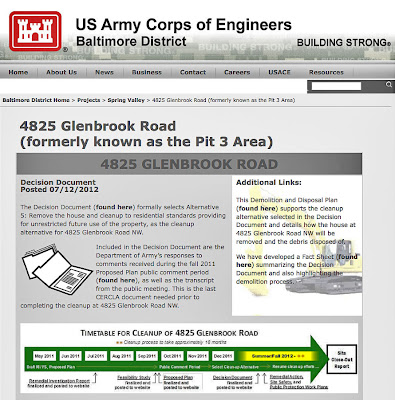
The house at 4825 Glenbrook Road ... will be removed in accordance with the approved Demolition and Disposal Plan. Details of the plan include using an excavator to systematically dismantle the interior and exterior of the house from top to bottom. To ensure the safety of the workers and the community, any part of the house that comes into contact with subsurface soils, including the basement slab and exterior basement walls, will remain in place and will be removed as part of the environmental cleanup action. House removal will take approximately two weeks, with activities Monday - Friday from 8 a.m. to 5 p.m.
Decision Document Fact Sheet

(7/12/12)

Jun 27, 2012

Advisory Board Ponders Impact of Stricter EPA Arsenic Standard

The Spring Valley Restoration Advisory Board this month heard about the stricter standards the U.S. Environmental Protection Agency is reportedly developing to measure safe levels of arsenic in soil and drinking water. Changes would mean that all the figures the Army Corps has used to determine soil safety in its Spring Valley cleanup "could be thrown out," board member Lee Monsein said at the board's June 12 meeting.

The Army Corps has been working to cleanup chemical and explosive munitions and related debris from the Spring Valley area since 1993. During World War I, the Army used American University as a testing site, firing weapons into the then-undeveloped woods around campus.


Nan Wells, an advisory neighborhood commissioner for the area, asked if the Army would have to clean up additional areas when the environmental agency sets new safety standards. The Army's Dan Noble, who co-chairs the advisory board, responded: "We are never going to walk away from a FUDS [Formerly Used Defense Site] site."

Northwest Current
June 27, 2012 ( pg. 5)

Jun 14, 2012

Glenbrook Rd. Deep Well Exceeds Arsenic MCL Down to 160 Feet

Multi-port deep well across street from Pit 3
Todd Beckwith (Project Manager): We collected two samples from this well. We did an initial sample in March and we went back out in April and collected another set of samples. So everything here highlighted in yellow represents chemistry results that were above the drinking water criteria. For both perchlorate and arsenic in these deeper intervals we're seeing some elevated concentrations ... The arsenic results were a little bit surprising. Back in 2005 - 2006 we had exceeded the MCL [maximum contaminant level] -- the 10 ppb standard -- just barely.

It was 10.5 then and since that time all of our sampling results for arsenic across all of Spring Valley have all been below 10 ppb, so we're a little surprised to see these concentrations ... We're going to go out and do some purging of this well; we'll pump a lot of water out of each one of those depth intervals. After we've done that, we'll collect a sample to make sure that the sample we send to the lab is truly representative of what's in that formation and the chemistry that we're seeing there hasn't been influenced by well construction activity.
Spring Valley FUDS

RAB Meeting Minutes
June 12, 2012

May 16, 2012

After 7 Months Cleanup Plan Still Awaiting Army Brass Signature

Army officials will likely grant final approval this month to demolish the house at 4825 Glenbrook Road, the site of a suspected burial pit of World War I-era debris. The U.S. Army Corps of Engineers plans to raze the house in July and excavate the site through summer 2013 ... The cleanup work at the property, which will remove potentially contaminated soil down to bedrock, will also encroach on the neighboring house at 4835 Glenbrook, now occupied by American University’s president. 
   
The Army Corps believes that property may include a possible “hot spot” of hazardous material beneath a retaining wall. Once the 4825 house is demolished, a protective cover will go over the excavation area to shield workers and neighbors from direct contact with possible contaminants. Workers will also install a chemical-agent filtration system, along with a generator and noise-control devices.
Northwest Current
May 16, 2012 (pg. 5)

May 9, 2012

Corps Will Investigate Last Nine "Areas of Interest" in Spring Valley

Plans are currently underway to perform additional soil sampling at four discrete areas, involving 18 residential properties and a portion of the AU campus ... The purpose of this additional sampling effort is to supplement the existing data to ensure sufficient information exists to make human health and ecological risk determinations. All sampling and investigative data, and the subsequent human health and ecological risk evaluations, will be presented in the site-wide Spring Valley Remedial Investigation report and available for public review upon its finalization (which is anticipated in 2014).
Kathleen Connell (RAB Member): Why was there a substantial delay between 1993 and 1999 and doing it now? If these were identified as properties that had potential interest, why was nothing done at that period of time?

Dan Noble
(Project Manager): We prioritized our requirements for the project. Each
year, as we got our money we spoke with the Partners about what needed to be done  and focused on what we felt needed to be done first. This effort is essentially collecting more data to further address some of the issues that came up during the 1999 EPA Risk Assessment ... This [investigation] would certainly bring an end to our field work, other than continued groundwater monitoring and the work at 4825 Glenbrook.
Spring Valley FUDS
RAB Meeting Minutes
May 8, 2012

Boldface AOI's remain to be investigated
 
Hit CountersFree Hit Counter