Nov 22, 2011

Perchlorate Levels in 16 Wells Lead to Source NE of Kreeger Bldg.

At the November Restoration Advisory Board meeting, the Army disclosed that -- in order to minimize disruption of the American University campus -- the anomalies identified during a 2½-acre geophysical survey of the Kreeger-Hamilton area last spring would be excavated over the upcoming winter break. Project Manager Todd Beckwith reported on findings from sixteen temporary wells drilled and tested for perchlorate across this identical site in July.

The highest levels detected were just northeast of and surrounding Kreeger Building: "SA 7 is where we detected 22 ppb in groundwater just a little bit upgradient of PZ 4," Beckwith announced. "SA 5, SA 3 and SA 15 also had notable concentrations of perchlorate ... it looks like we've bounded the perchlorate source area, meaning that it seems to be more confined to this area." When asked precisely what activities took place there during World War I, Project Manager Dan Noble observed: "That was the Experiment Station. There were labs and little pilot production facilities. There was a lot of activity going on right here" [SA 7].

Spring Valley RAB
Meeting Minutes
November 8, 2011 (pg. 12)

Kreeger from Hamilton parking lot; Source Area 7 is under pylon

Nov 16, 2011

Fused 75mm Shell Found Along Hwy. in Vicinity of WW I Railroad

Army Corps project manager Dan Noble announced that workers are now looking in 38 acres of the Dalecarlia Woods for buried ammunition and other material from the testing program. Noble, who co-chairs the board, reported that a 75-millimeter shell was found 10 inches beneath the surface of the highway right-of-way on the residential side of Dalecarlia Parkway.
Northwest Current

November 16, 2011 (pg. 3)

NOTE: 75mm shell actually located two grids(acres) farther south
NOBLE: Yesterday, on the first day of digging, in grid H-4 they came across an intact munition along the Dalecarlia Parkway. It was about 25 feet off the parkway, about ten inches down: a 75mm. It was fused. We don't usually find fused items ... With the assistance of DC (because it was along the parkway during rush hour), we asked DC Metro police to come out. The bomb squad responded and they shut down a lane of Dalecarlia for us while we got the item out ...

SLOWINSKI: Can you point out where the narrow-gauge railroad is?


NOBLE: No, I can't ...

BECKWITH: Well, AOI #2 is listed here, so I think it's in that general vicinity.

SLOWINSKI: So would it cross Dalecarlia approximately where the munition was found?

BECKWITH: The narrow-gauge rail? ... I don't know. We speculated that that rail was related to either construction of the reservoir on aqueduct property or it could been from the timber operation for removing some timber when they put in this big water main that went through here ...

SLOWINSKI: My understanding is that the narrow-gauge railroad ran primarily East - West, whereas the pipeline goes primarily North - South.

NOBLE: I have no information to add.
Spring Valley RAB Meeting
November 8, 2011 (audio recording)


After much delay because of a lack of labor, the famous "Hillside Express," or perhaps better known as the "Death's Valley Limited," narrow-gauge tramway is rapidly being completed. This railway, which will convert bleak hillsides and hopeless hollows into busy manufacturing districts, is almost open for service. Already it is being used to a great extent in a limited capacity, such as hauling stills and other heavy machinery up and down the line. The passenger coaches for hauling the men to and from work have not been put into service yet, but Pvt. Ward, the constructing genius, promises them some time in the very near future. 
The Retort
October 6, 1918


Survey flags trace abandoned narrow-gauge railroad bed
In November, field teams continued investigating buried metallic anomalies in the Dalecarlia Woods geophysical investigation area. Three munition items and approximately 20 munitions debris items have been recovered since this investigation began in October 2011. The Dalecarlia Woods anomaly investigation effort is expected to be completed in early 2012.
Spring Valley Project Summary

November 2011

Nov 2, 2011

Cleanup Plan Will Wipe "Notorious Address" Off the Face of the Map

Congresswoman Norton (D-DC) and Carrie Johnston (USACE)
At a public meeting on Oct. 26, the Army Corps formally presented its plan to remove chemical materials deemed unsafe from the AU-owned property 4825 Glenbrook Rd., adjacent to the Kreeger building parking lot. The proposed plan, which AU endorses, is to demolish the unoccupied house on the property, excavate much of the yard and restore the lot to residential standards ... Munitions, laboratory glassware and tons of contaminated soil have already been removed from the site, but the Army Corps believes there is more to be found along the sides of the home’s foundation. Army Corps has been excavating a WWI chemical munitions burial pit beneath the property since 2007, until several jugs containing arsenic trichloride, a toxic gas, were found in March 2010, The Eagle previously reported.
Sylvia Carignan
The Eagle
November 1, 2011


“The demolition of this house and cleanup of the affected grounds will remove one of the last known contaminated properties,” [Congresswoman Eleanor Holmes] Norton (D-DC) said. “This property has become a monument to the contamination that has marred a beautiful neighborhood. I hope that when this house comes down and the property is cleaned up, it will signal that we have come close to eliminating the contamination in this neighborhood. A watch period will then begin to ensure that this time all the contamination has been eliminated.”
Congresswoman Eleanor Holmes Norton
Press Release (October 26, 2011)

Oct 26, 2011

Army Drilling Deep Wells to Test Valley Bedrock for Perchlorate

Second deep well being drilled at 4820 Glenbrook Road
Two new wells bored 200 feet below Spring Valley represent the latest step in an ongoing effort by the U.S. Army Corps of Engineers to determine the source of groundwater contamination and where that contamination is spreading. The Army Corps has been studying Spring Valley's groundwater since 2005 and has found, just below the ground, concentrations of the chemical perchlorate that significantly exceed drinking water standards ... The planned Kreeger Hall excavation should determine that source, according to [Army Corps project manager Todd] Beckwith. A survey over the summer with advanced metal detectors found "anomalies" that could be buried Army waste causing the contamination, he said.
Brady Holt
Northwest Current
October 26, 2011 (pg. 1)


Oct 3, 2011

Proposed Plan Posted for Review; Public Mtg. Oct. 26th at Library

ddd
The US Army Corps of Engineers ... proposes a remedy to address the cleanup created by the presence of chemical warfare materiel, agent breakdown products, munitions and explosive of concern, and hazardous and toxic waste-impacted soil found at the 4825 Glenbrook Road site.

... This notice serves as notification of the availability of the 4825 Glenbrook Road Proposed Plan for review, and the commencement of the 30-day public comment period ... Written comments should be mailed to Brenda Barber at the address below and must be postmarked by Nov. 12, 2011 to be considered. Attendees at the public meeting may provide oral comments or bring written comments to the Meeting Recorder.
Public Notice:
4825 Glenbrook Road Proposed Plan
Available for Public Review (October 3, 2011)

Sep 30, 2011

University Will Only Consider “Alternative 5” as Acceptable

Proposed High & Low Probability Excavations

Alternative 5 is the cleanup alternative that is most effective and protective of human health and the environment. It is the only alternative that removes the long-term risk posed by the 4825 Glenbrook Road site by excavating the property (Areas A, B, D, E and F), including the area beneath the house (Area E), to competent saprolite or bedrock; Alternative 5 provides the best long-term solution for minimizing future risk at the site.  

… Area A will address any potential World War I related materials that may remain behind the retaining wall in the backyard of the property. If AUES related items, such as munitions and laboratory glassware, are found in Area A, the Army will continue excavating behind the retaining wall until the AUES related waste has been identified and removed.

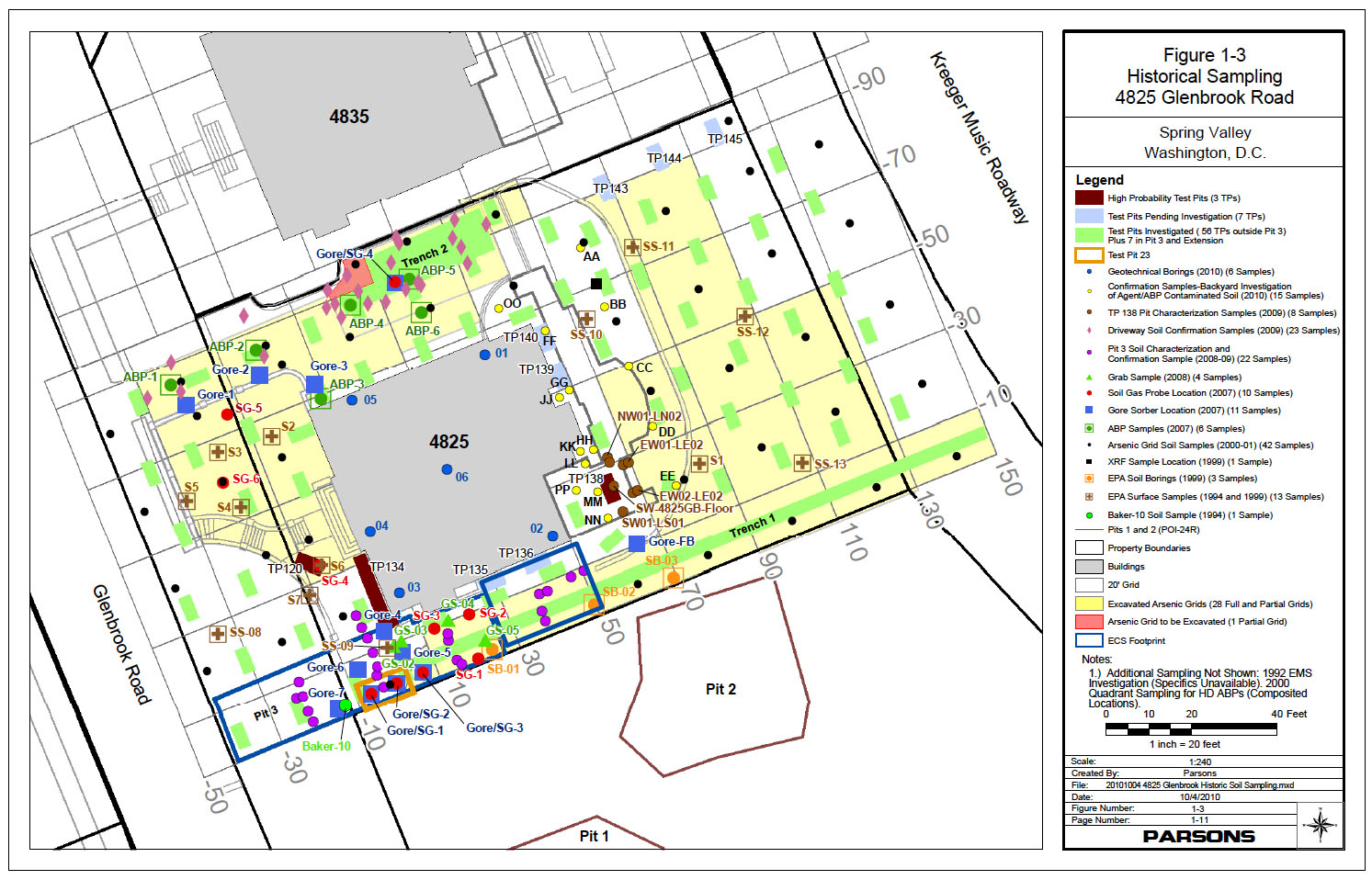
Historical Sampling at 4825 Glenbrook Road

AU does not consider any remedial alternative other than "Alternative 5, Removing the House and cleaning up to Residential standards with Unrestricted Future Use,” to be acceptable.

... AU has commented repeatedly regarding the arsenic cleanup level of 20 mg/kg and has been repeatedly ignored. While 20 mg/kg may be appropriate as an action level or screening level, it is not appropriate as remedial goal especially at a site where there are so many chemical and toxicological uncertainties in the assessment of the nature and extent of contamination. Even a rough calculation reveals that the residual lifetime cancer risk associated with residential exposure to 20 mg/kg exceeds 5:100,000.

Sep 18, 2011

Army Corps Would Excavate to Bedrock at Glenbrook Road Site

Detailed Analysis of Remaining Alternatives
"While Alternative 5 is the most expensive, it was ranked as favorable in five out of six of the nine criteria that were ranked [above] ... The new figure [below] visually depicts Alternative 5 and highlights the areas that we would excavate. Areas A, B, D, E and F are all the areas that we would excavate to bedrock or competent saprolite under Alternative 5."
Brenda Barber, Project Manager
RAB Meeting
September 13, 2011


Remedial Actions Under Alternative 5
 
Hit CountersFree Hit Counter