Oct 26, 2011

Army Drilling Deep Wells to Test Valley Bedrock for Perchlorate

Second deep well being drilled at 4820 Glenbrook Road
Two new wells bored 200 feet below Spring Valley represent the latest step in an ongoing effort by the U.S. Army Corps of Engineers to determine the source of groundwater contamination and where that contamination is spreading. The Army Corps has been studying Spring Valley's groundwater since 2005 and has found, just below the ground, concentrations of the chemical perchlorate that significantly exceed drinking water standards ... The planned Kreeger Hall excavation should determine that source, according to [Army Corps project manager Todd] Beckwith. A survey over the summer with advanced metal detectors found "anomalies" that could be buried Army waste causing the contamination, he said.
Brady Holt
Northwest Current
October 26, 2011 (pg. 1)


Oct 3, 2011

Proposed Plan Posted for Review; Public Mtg. Oct. 26th at Library

ddd
The US Army Corps of Engineers ... proposes a remedy to address the cleanup created by the presence of chemical warfare materiel, agent breakdown products, munitions and explosive of concern, and hazardous and toxic waste-impacted soil found at the 4825 Glenbrook Road site.

... This notice serves as notification of the availability of the 4825 Glenbrook Road Proposed Plan for review, and the commencement of the 30-day public comment period ... Written comments should be mailed to Brenda Barber at the address below and must be postmarked by Nov. 12, 2011 to be considered. Attendees at the public meeting may provide oral comments or bring written comments to the Meeting Recorder.
Public Notice:
4825 Glenbrook Road Proposed Plan
Available for Public Review (October 3, 2011)

Sep 30, 2011

University Will Only Consider “Alternative 5” as Acceptable

Proposed High & Low Probability Excavations

Alternative 5 is the cleanup alternative that is most effective and protective of human health and the environment. It is the only alternative that removes the long-term risk posed by the 4825 Glenbrook Road site by excavating the property (Areas A, B, D, E and F), including the area beneath the house (Area E), to competent saprolite or bedrock; Alternative 5 provides the best long-term solution for minimizing future risk at the site.  
… Area A will address any potential World War I related materials that may remain behind the retaining wall in the backyard of the property. If AUES related items, such as munitions and laboratory glassware, are found in Area A, the Army will continue excavating behind the retaining wall until the AUES related waste has been identified and removed.

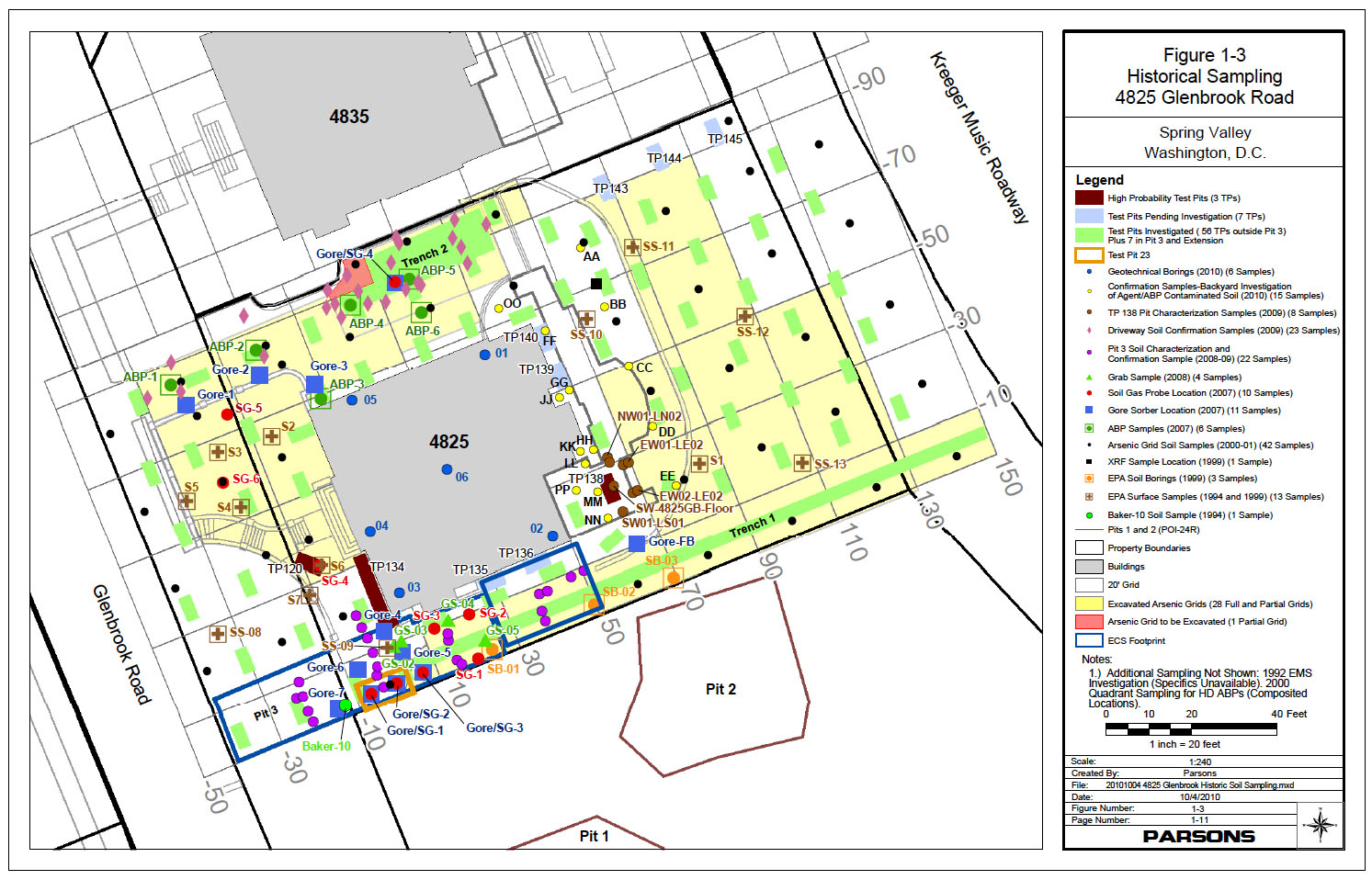
Historical Sampling at 4825 Glenbrook Road

AU does not consider any remedial alternative other than "Alternative 5, Removing the House and cleaning up to Residential standards with Unrestricted Future Use,” to be acceptable.

... AU has commented repeatedly regarding the arsenic cleanup level of 20 mg/kg and has been repeatedly ignored. While 20 mg/kg may be appropriate as an action level or screening level, it is not appropriate as remedial goal especially at a site where there are so many chemical and toxicological uncertainties in the assessment of the nature and extent of contamination. Even a rough calculation reveals that the residual lifetime cancer risk associated with residential exposure to 20 mg/kg exceeds 5:100,000.

Sep 18, 2011

Army Corps Would Excavate to Bedrock at Glenbrook Road Site

Detailed Analysis of Remaining Alternatives
"While Alternative 5 is the most expensive, it was ranked as favorable in five out of six of the nine criteria that were ranked [above] ... The new figure [below] visually depicts Alternative 5 and highlights the areas that we would excavate. Areas A, B, D, E and F are all the areas that we would excavate to bedrock or competent saprolite under Alternative 5."
Brenda Barber, Project Manager
RAB Meeting
September 13, 2011


Remedial Actions Under Alternative 5

Sep 11, 2011

Corps Admits Having Transcript; Will Try to Locate Home Builders

In response to a question from commissioner Kent Slowinski following her presentation at the September 9th Advisory Neighborhood Commission 3-D meeting, U.S. Army Corps of Engineers project manager Brenda Barber acknowledged that a ten-year-old videotape transcript, of an interview with construction workers who helped build the house at 4825 Glenbrook Road in 1992, is in the Army's possession. 

SLOWINSKI (33:12): Have you talked to the construction workers who built the house, many of whom suffered exposure to chemical warfare agent? ... There's a videotaped interview where the construction workers were sitting around a site plan of the property and they pointed to areas on the property where they said they found munitions or bottles filled with chemicals. They even went on to say, "You can find more munitions behind this wall."
4825 Glenbrook Road Project Mgr. Brenda Barber
BARBER (33:55): Yes, we have copies of the transcripts from those videotapes and our legal counsel is actually engaged in trying to find out the names of those employees so that we can do additional interviews with them.
U.S. Army Corp of Engineers presentation
ANC 3-D Meeting (audio recording)
September 7, 2011

[DC Department of Health environmental scientist] Richard Albright investigated further and found that five workers building 4825 Glenbrook Road had fled the site in May 1992 when fumes from broken lab glassware and contaminated soil caused pain in their eyes and lungs. Suffering from eye pain and burning skin, some of the workers went to a hospital emergency room. It was beginning to look as if both [AU President Benjamin] Ladner's house [at 4835] and 4825 Glenbrook had been built on top of a laboratory-waste dump.
Harry Jaffe

The Washingtonian
December 1, 2000

Aug 9, 2011

Proposed Army Cleanup Would Demolish Glenbrook Road House

The U.S. Army Corps of Engineers is recommending tearing down a Spring Valley home to identify and remove World War I-era munitions and chemicals feared to be buried beneath it. Since 2000, the Army Corps has removed more than 500 munitions items, 400 pounds of laboratory glassware and more than 100 tons of soil contaminated with arsenic and other hazardous substances from 4825 Glenbrook Road, officials said.


...
In 1918, 4825 Glenbrook Road was a dumpsite for chemical and explosive munitions and related debris; officials believe a pit was disturbed when the home was built, scattering that material throughout the property. The Army is now proposing to clean up whatever it finds beneath the home to a depth of 12 feet, spending an estimated $12.5 million to restore the site to residential standards.
Brady Holt
Northwest Current
August 10, 2011 (pg. 1)

Aug 6, 2011

Campus Groundwater Sampled in Ongoing Perchlorate Investigation

No Entry: Source Area Investigation
The installation of sixteen temporary wells at American University in the vicinity of Kreeger Hall was completed in an effort to identify the source of elevated perchlorate levels in the groundwater in this area. The wells were installed, sampled and closed during a three-week period in July ... Also this month, data generated from the first quarterly sampling effort in May at existing groundwater monitoring wells and surface water locations, such as creeks and streams, was reviewed.


Drilling for Groundwater at Source Area #2
The field team plans to conduct the second quarterly sampling effort the first week of August to assess whether seasonal fluctuations affect contaminant levels in groundwater within the Spring Valley project area. Three new deep groundwater monitoring wells are expected to be installed later this year to determine if perchlorate has migrated into the deeper groundwater flow areas.
 
Hit CountersFree Hit Counter