Sep 30, 2012

University Students Barred from Advisory Board Membership


The Spring Valley Restoration Advisory Board recently announced that students cannot participate in board discussions on the basis that they are not permanent D.C. residents ... The Eagle would like to point out a few factors: 
 
First, although each individual student at AU only lives in D.C. for about four years, AU is not moving and the Spring Valley community will always have a student presence in the area.  The AU student body is a permanent resident and therefore deserves a say.
 
Second, D.C. is a transient city.  Every four years (or more often than that), new rotations of politicians move into the D.C. metropolitan area.  Members of the House of Representatives are potentially only here for two years.  As populations other than students come and go, it seems that the board’s members are targeting students specifically.  
  
Third, AU students do their research.  When students become involved with something, they study it ... Board members may be concerned that students won’t understand the jargon or complexity of neighborhood issues.  This may be a legitimate concern at a different university, but at AU, if students are given the opportunity to represent themselves, they take it.

 
[1.1.] The purpose of the Board is to provide a forum and mechanism to ensure: a) independent community awareness, b) review and assessment of proposed actions by the Corps and c) the Corps’ consideration of community concerns as they proceed with environmental testing, analysis, remediation and restoration of the Spring Valley neighborhood, pursuant to the contamination and potentially dangerous material remaining in ground as a result of activities of the American University Experimental Station, a Formerly Used Defense Site ...
 
[3.1.3.] The community members are individual residents and/or workers in the area who may be affected by environmental restoration activities in the Spring Valley FUDS, and who provide their advice, opinions and judgments as individuals ...
  
[4.2.2.] Community members selected for the Spring Valley RAB must live and/or work in the affected community, or be affected by the installation’s environmental restoration program.

Sep 18, 2012

Mother of Two Appeals to Spring Valley RAB Over Denied Relocation

DIETERICH (Resident, 4830 Glenbrook Road)There is a really immediate direct risk to our property — much more than anyone else in the neighborhood ... The Army Corps in the mean time has twice rejected our request — we are getting only "no's," so we ask for your support to be relocated. I don't want our children to be in that house when the Army is digging for chemical weapons just yards from our property ... There are enormous risks, there are enormous uncertainties about what they're going to find ... Things go wrong. It's a marginal risk. Not a high one, but a marginal risk when it comes to highly poisonous substances is too big a risk for my children.
 
WHISNANT (Principal, Horace Mann Elementary School): We certainly have been promoting walking to school ... and they're walking access is along Glenbrook Road. We have been in touch with AU about the possibility of using their back gate as an alternate route or that is something that can be disbanded  The presence of those two children across the street cannot be easily rerouted and disbanded unless, I think, this Restoration Advisory Board has a voice that says (I don't know how you talk about "acceptable risk" when there is no acceptable risk) remove them and support their removal. 

Spring Valley RAB Meeting 

Christine Dieterich, who lives directly across the street from the site at 4825 Glenbrook Road with two children, said she is worried about adverse effects from chemicals will harm her family during the construction.  The Army Corps denied her two requests for the Corps to pay for her temporary relocation because the construction would be monitored and precautions were in place.
          
“Systems fail, things go wrong and engineers are human, not God,” Dieterich said during the Spring Valley meeting on Sept. 11.  Dieterich appealed to the board, but members said they could not make a decision until they had more evidence of the site’s risks.  However, only Corps Headquarters would be able to overturn the current decision.  Dr. Peter deFur, an environmental scientist who served on the National Research Council Board on Environmental Studies and Toxicology, will release a study on the construction site’s chemical risks. 

The Eagle 
September 20, 2012 (pg. 6)

The house to be demolished at 4825 Glenbrook Rd is approximately 45 feet from the near edge of Glenbrook Road, the road is about 30 feet wide, for a total distance of about 75 feet from the house to the property boundary across the street ... The Corps makes assumptions about the worst that might happen, termed the Maximum Credible Event -- what might occur if the containment failed with a chemical release, in this case a liter of arsenic trichloride.  The Corps estimates that a person needs to be more than 161 feet from such a release in order to experience only minor discomfort from the release.  For distance less than 161 feet from a release, a person needs to take precautions to remain safe in the event of a release.  
September 18, 2012

Aug 9, 2012

New Approach Needed to Destroy Buried CWM at 250 Military Sites

WASHINGTON — The current approach for identifying and destroying buried chemical munitions and related chemical warfare materials uncovered during environmental remediation projects is neither reliable enough nor has the capability to efficiently tackle large-scale projects, says a new report from the National Research Council ...
Remediation of Buried Chemical Warfare Materiel
Following a 1985 directive from Congress, the Army has undertaken the monumental task of destroying the existing U.S. stockpile of chemical weapons. To date, 90 percent of the stockpile has been destroyed, and the remaining 10 percent is expected to be destroyed by 2022. However, during the early- to mid-20th century, chemical weapons and chemical warfare materiel were often disposed of by open pit burning and burial at approximately 250 sites in 40 states, the District of Columbia and three territories.
Remediation of this buried materiel, in addition to environmental cleanup of the burial sites, therefore poses significant challenges to the nation and DOD. The report examines important regulatory issues that ultimately affect the need, timing, and costs of remediating these sites. Federal and state environmental remediation policies address whether buried CWM must be excavated and destroyed or contained in place ...

FUDS with buried chemical WMD
The report recommends as a "matter of urgency" that the secretary of defense increase funding for the remediation of chemical warfare materiel to enable the Army to complete the inventories of known and suspected buried chemical munitions no later than 2013.
Remediation of Buried Chemical Warfare Materiel
National Academy of Sciences
August 6 2012

Aug 6, 2012

Family Asks to be Relocated During Demolition of Glenbrook House

A family on Glenbrook Road has asked the U.S. Army Corps of Engineers to pay for them to rent a home while the house across from theirs -- at 4825 Glenbrook -- is demolished ... The resident, who asked that her name not be published, has a 1-year-old and a 5-year-old and is worried that a problem could occur during the demolition. She said in an interview that her request was rejected by the Corps and has since gone to the appeal level. Dan Noble, co-chair of the Spring Valley Restoration Advisory Board and project manager of the area's cleanup, said he could not comment, as the matter is in the midst of "a formal legal process."

USACE Poster Session (7/17/12)
The Corps had hoped to knock down 4825 Glenbrook during the university's summer vacation, but because of delays in getting approval, work will probably take place this fall. "We can accommodate demolition during the school year," said [project manager Brenda] Barber, adding that the work should take between two and three weeks and be completed by the end of fall. Barber said additional engineering work must be done to protect adjacent properties, including the home of American University President Neil Kerwin and the South Korean ambassador's residence. "We are working very closely with AU," she said. Once work starts, Barber said, the Corps will post weekly updates on the project website, which can be found at tinyurl.com/corps-cleanup.
Northwest Current
July 25, 2012 (pg. 5)

Jul 12, 2012

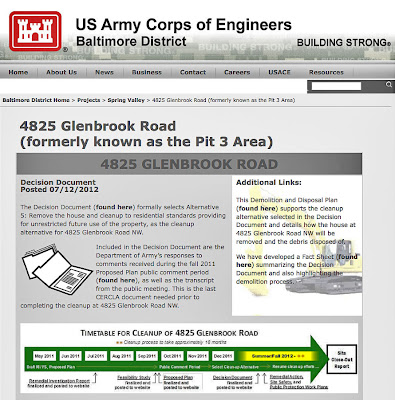
Corps will Detail House Demolition Plan at Public Meeting Tuesday

A combined Restoration Advisory Board / Community Meeting will be held at the Metropolitan Memorial United Methodist Church beginning at 7:00 PM on Tuesday, July 17. The purpose of this meeting is to share details on the Army's Demolition and Disposal Plan for 4825 Glenbrook Road NW, which outlines how the house at the property will be removed and the debris disposed of. The meeting will be in the second floor Great Hall of the church located at 3401 Nebraska Avenue. Parking is available at the church.
Spring Valley FUDS Project Summary

June 2012


The house at 4825 Glenbrook Road ... will be removed in accordance with the approved Demolition and Disposal Plan. Details of the plan include using an excavator to systematically dismantle the interior and exterior of the house from top to bottom. To ensure the safety of the workers and the community, any part of the house that comes into contact with subsurface soils, including the basement slab and exterior basement walls, will remain in place and will be removed as part of the environmental cleanup action. House removal will take approximately two weeks, with activities Monday - Friday from 8 a.m. to 5 p.m.
Decision Document Fact Sheet

(7/12/12)

Jun 27, 2012

Advisory Board Ponders Impact of Stricter EPA Arsenic Standard

The Spring Valley Restoration Advisory Board this month heard about the stricter standards the U.S. Environmental Protection Agency is reportedly developing to measure safe levels of arsenic in soil and drinking water. Changes would mean that all the figures the Army Corps has used to determine soil safety in its Spring Valley cleanup "could be thrown out," board member Lee Monsein said at the board's June 12 meeting.

The Army Corps has been working to cleanup chemical and explosive munitions and related debris from the Spring Valley area since 1993. During World War I, the Army used American University as a testing site, firing weapons into the then-undeveloped woods around campus.


Nan Wells, an advisory neighborhood commissioner for the area, asked if the Army would have to clean up additional areas when the environmental agency sets new safety standards. The Army's Dan Noble, who co-chairs the advisory board, responded: "We are never going to walk away from a FUDS [Formerly Used Defense Site] site."

Northwest Current
June 27, 2012 ( pg. 5)

Jun 14, 2012

Glenbrook Rd. Deep Well Exceeds Arsenic MCL Down to 160 Feet

Multi-port deep well across street from Pit 3
Todd Beckwith (Project Manager): We collected two samples from this well. We did an initial sample in March and we went back out in April and collected another set of samples. So everything here highlighted in yellow represents chemistry results that were above the drinking water criteria. For both perchlorate and arsenic in these deeper intervals we're seeing some elevated concentrations ... The arsenic results were a little bit surprising. Back in 2005 - 2006 we had exceeded the MCL [maximum contaminant level] -- the 10 ppb standard -- just barely.

It was 10.5 then and since that time all of our sampling results for arsenic across all of Spring Valley have all been below 10 ppb, so we're a little surprised to see these concentrations ... We're going to go out and do some purging of this well; we'll pump a lot of water out of each one of those depth intervals. After we've done that, we'll collect a sample to make sure that the sample we send to the lab is truly representative of what's in that formation and the chemistry that we're seeing there hasn't been influenced by well construction activity.
Spring Valley FUDS

RAB Meeting Minutes
June 12, 2012
 
Hit CountersFree Hit Counter